
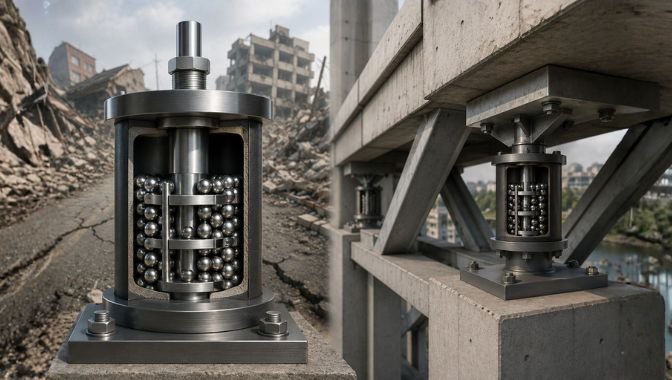
Scientists have developed a new mechanical system designed to reduce earthquake damage in buildings and bridges without using electricity. The invention could help protect infrastructure during disasters that often cause power failures.
A simple mechanical approach to earthquake safety
The device uses a hollow steel cylinder filled with steel balls. A central shaft moves inside the cylinder when vibration occurs. This motion creates friction between the steel balls and internal rods.
That friction converts vibration energy into heat and internal movement. As a result, less energy reaches the structure itself.
Researchers say the system works as a passive shock absorber. It does not rely on sensors, software, or external power sources.
Designed for extreme conditions
Earthquakes, strong winds, and heavy machinery vibrations can all damage buildings and bridges. Engineers describe this damage control process as “energy dissipation,” where harmful vibration energy is absorbed before it spreads through the structure.
Traditional systems often depend on electronic components. Those systems can fail during power outages, which often happen after major earthquakes.
This new device avoids that risk by operating entirely without electricity.
Potential use in critical infrastructure
The system could be useful in hospitals, bridges, laboratories, and communication centers. These facilities need to stay stable during emergencies.
The inventor says the design is based on “pure physics” and uses only motion and friction to reduce impact forces.
Also read Farhan Saeed Talks About Playing a Young Student in New Drama
Early tests show the system can absorb a significant portion of vibration energy, with promising results in controlled experiments.
A step toward safer buildings
Researchers continue to study how passive damping systems can improve earthquake resistance. The steel ball device adds a new approach to this field by focusing on simplicity and reliability.
If widely adopted, the technology could help reduce structural damage and improve safety in earthquake-prone regions.

