
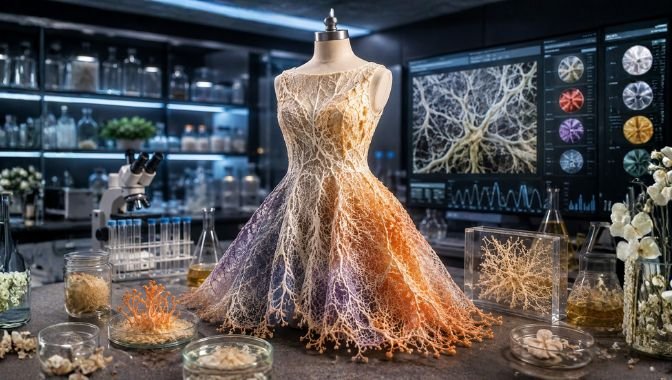
Scientists in China have developed a new type of living textile that can clean itself, renew its surface, and partially repair damage. The experimental material uses fungal mycelium and could offer a new approach to sustainable clothing and other products.
Researchers at the Shenzhen Institutes of Advanced Technology developed the material as an engineered living material, or ELM. Their findings appeared in the peer reviewed journal Science Advances.
Unlike conventional fungal materials, the new textile keeps dormant Cordyceps militaris mycelium alive inside its structure. The researchers designed the material to preserve biological activity while giving it the appearance and flexibility of a textile.
Living fabric can renew damaged areas
The fungal textile enters a dormant state after researchers dry it at 45 degrees Celsius. According to lead researcher Ke Li, the process reduces the fungus’s metabolic activity without completely destroying it.
Researchers can reactivate the mycelium by applying a nutrient solution made from potato water. The treatment encourages the fungus to produce new filaments that spread across the material and renew its surface.

The researchers also tested the material’s ability to repair larger holes. They placed fresh mycelium inside damaged areas and added nutrients. New fungal growth then expanded across the gaps and connected the damaged sections.
This process could eventually reduce the need for adhesives, stitching, or replacement materials in certain applications. However, researchers still need to improve the technology before it can support everyday products.
The textile also has natural self cleaning properties. Its aerial mycelium creates a water repellent surface with a water contact angle of around 145 degrees. As a result, dirty water droplets can roll across the surface and carry residue away.
Fungi could add colors and other features
The researchers designed the textile as a programmable platform that can gain additional functions through other organisms.
Engineered yeast can attach to the fungal material and produce several colors. The team demonstrated shades including light blue, red, orange, and dark purple.
Researchers also introduced Aspergillus niger to create a melanin rich fungal layer. This layer can increase UV absorption and provide antioxidant properties.
The team demonstrated the concept by creating a prototype dress from several fungal textile sections. Some areas provided biological coloring, while others offered self cleaning properties.
The technology could eventually support products that combine appearance, controlled repair, biodegradability, and a defined lifespan. These features could make living materials attractive for fashion and other specialized applications.
The researchers also stressed that the material remains experimental. They need to address several challenges before commercial use becomes possible. These include durability, moisture resistance, safety, and consistent manufacturing.
Also read Why OpenAI Is Holding Back Its Powerful New AI Model Astra
The research highlights a growing field of engineered living materials that combines biology with material science. Instead of treating organisms only as raw materials, scientists are exploring ways to keep them active so they can perform useful functions.
If researchers can overcome the current limitations, living textiles could offer new possibilities for sustainable clothing and other products. For now, the fungal fabric remains a promising laboratory development rather than a ready to wear alternative to conventional textiles.

