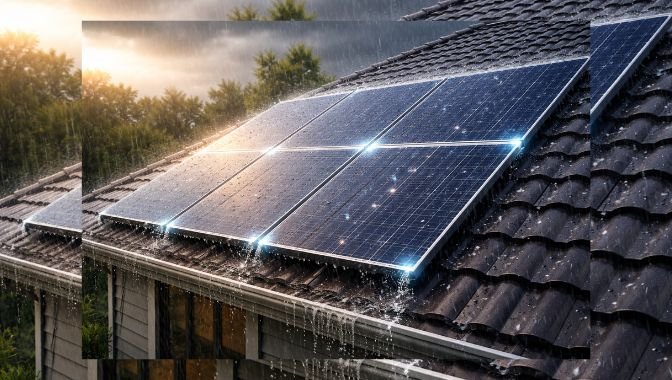
Researchers at the Institute of Materials Science of Seville have developed a groundbreaking hybrid device that generates electricity from both sunlight and rainfall at the same time. The innovation addresses one of the biggest limitations of traditional solar technology, which stops producing power when clouds and rain arrive.
The device combines advanced perovskite solar cells with triboelectric nanogenerators, creating a continuous energy source that works regardless of weather conditions.
How the Hybrid Solar Rain Device Works
The technology uses a patented plasma coated thin film that serves two critical purposes. First, it protects the perovskite solar cells from environmental damage caused by humidity, temperature fluctuations, and harsh outdoor conditions. Second, it enables the device to harvest energy from rainfall through triboelectric nanogenerators built into the same structure.
Each raindrop that strikes the device generates more than 100 volts of electricity. This is enough to power small electronic devices independently. As a result, the device continues producing usable energy even during heavy rain when conventional solar panels sit idle.
Perovskite solar cells offer significant advantages over traditional silicon cells. They are highly efficient and considerably more cost effective to produce. However, their main weakness has always been their tendency to degrade under harsh environmental conditions. The new plasma coating solves this problem directly by shielding the cells chemically while also enhancing their light absorption capacity.
ICMS researcher Carmen Lopez explained that the device ensures continuous energy generation, powering portable electronics and Internet of Things devices in all weather conditions. This capability makes the technology particularly valuable for applications that require reliable and uninterrupted power in outdoor environments.
Real World Applications and Future Potential
The practical applications for this hybrid device are wide ranging and significant. Researchers identify several key areas where the technology could make an immediate impact. These include environmental sensors, structural monitoring systems, smart city infrastructure, and remote energy stations in areas where grid power is unavailable or unreliable.
Smart city infrastructure stands to benefit enormously from a device that generates power continuously without depending on weather conditions. Furthermore, environmental monitoring sensors placed in remote locations could operate independently for extended periods without requiring battery replacements or external power connections.
The hybrid device also opens new possibilities for Internet of Things networks, where thousands of small connected devices require constant but low level power to function. Additionally, the technology could support structural health monitoring systems on bridges, buildings, and other infrastructure where continuous sensor operation is critical.
Research Background and Development
The Spanish research team developed the hybrid device under two major initiatives. These are the ERC funded 3DScavengers project and the Drop Ener initiative. Both programs focus on combining advanced nanogenerator technology with next generation solar materials to create sustainable and autonomous power solutions.
Also read Khushhal Khan Clarifies Wedding News and Promotes Upcoming Drama Winter Love
The collaboration between the Spanish National Research Council and the University of Seville brought together expertise in materials science, energy harvesting, and nanotechnology. Consequently, the resulting device represents a convergence of multiple cutting edge research areas into a single practical solution.
As global demand for clean and reliable energy continues to grow, innovations like this hybrid solar rain device point toward a future where energy harvesting becomes truly weather independent and continuously available.